




THE HEART OF THE DIVINE LITURGY
The Eucharist is the culmination of the Divine Liturgy and stands at the center of the sacramental life of the Orthodox Church. The word Eucharist comes from Greek and means thanksgiving.
During the Liturgy, bread and wine are offered to God. The Church thanks God for His creation, for the redemption in Christ, and for everything He has given to humanity. Then the priest prays that the Holy Spirit descends upon the offered gifts and sanctifies it.
For Orthodox Christians, the sacred gifts are not merely a reminder or symbol. In the Holy Communion, they truly receive the Body and Blood of Jesus Christ.
THE BREAD AND THE WINE
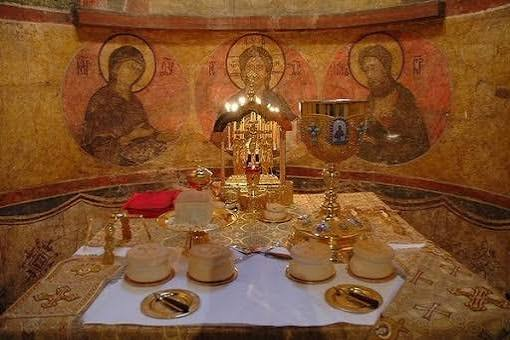
For the Liturgy, a special bread is prepared. From this bread, the central part is taken that it Lamb is mentioned and is consecrated during the Eucharist.
Wine is also prepared and brought into the holy chalice.
These gifts refer directly to Christ and to the Last Supper, where He took the bread and said: "This is My Body," and the cup gave as His Blood.
The Eucharist is therefore closely connected with the suffering, death, and resurrection of Christ, but also with the expectation of His Kingdom.
AFTER THE OUR FATHER
After the Our Father the Liturgy approaches its most solemn moment.
The believers bow their heads and pray to be worthy to partake of the Holy Gifts. The priest prays that Christ Himself, who is invisibly present, grants His Body and Blood to His people.
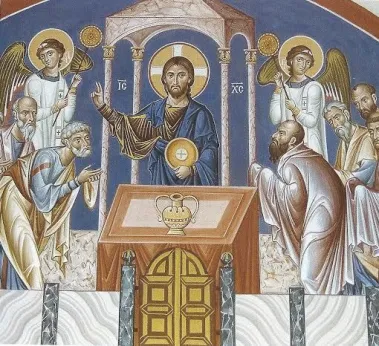
The holy Lamb is then lifted up with the words:
"The Holy for the holy ones."
The community responds:
"One is holy, one is Lord: Jesus Christ, to the glory of God the Father. Amen."
With this, the Church confesses that holiness does not come from man himself, but from Christ.
THE HOLY COMMUNION
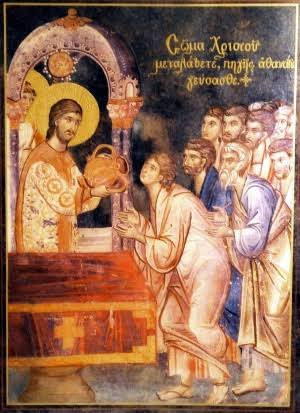
First, the clergy receive the Holy Communion. Then, the believers are invited to come forward.
In the Orthodox Church, the faithful receive the consecrated bread and wine. together of a communion spoon.
For receiving Communion, a prayer is said in which each believer personally confesses their faith in Christ, asks for forgiveness, and prays that the Holy Mysteries will not be for judgment or condemnation, but for healing of soul and body and to eternal life.
During Communion, among other things, the following is sung:
"Receive the Body of Christ, taste the Fountain of immortality. Alleluia."
The Eucharist is therefore not only something that an orthodox Christian observes. It is a true participation in the life of Christ and in the life of the Church.
CHILDREN ALSO RECEIVE COMMUNION
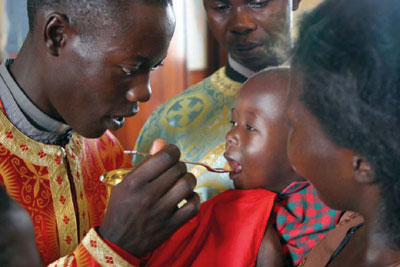
A visible difference with various Western Christian traditions is that within the Orthodox Church also young children and babies receive the Holy Communion.
Children who have been fully incorporated into the sacramental life of the Church through Baptism and Confirmation are not considered future members of the Church. They are already members of the Church and can therefore also participate in the Eucharist.
The way a child consciously prepares for Communion later grows along with his or her age and spiritual development.
PREPARATION FOR COMMUNION
The Holy Communion is approached with great reverence within the Orthodox Church.
Orthodox Christians prepare through prayer, repentance, and a life of faith. Depending on the local church practice, fasting, confession, and special prayers may also be part of that preparation.
The Eucharist is therefore not intended as a separate religious act. It is part of a life in which the believer continually tries to turn back to Christ.
Whoever attends an Orthodox Liturgy but does not belong to the Orthodox Church is heartily welcome to participate in and observe the worship serviceThe Holy Communion itself is intended for Orthodox Christians who belong sacramentally to the Church and have prepared themselves according to church practice.
COMMUNION AND COMMUNITY
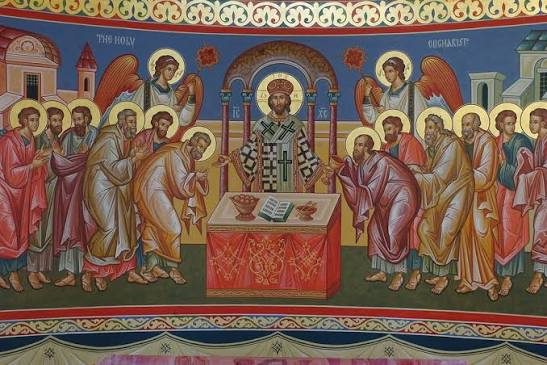
The word Communion also means communityThat takes on a special meaning in Curaçao.
Orthodox Christians on the island may come from different countries, languages, and church traditions. Some have lived here for years, others are temporarily in Curaçao, and still others are just becoming acquainted with Orthodox Christianity. Nevertheless, Orthodox believers in the Eucharist are not primarily connected by origin or nationality, but by Christ and the Common Faith of the Church.
The Eucharist thus shows that the Orthodox Church is not a church of just one people or culture. Greek, Russian, Serbian, Arabic, Dutch, or Curaçaoan: in the Liturgy, people come together as one community around Christ.
This is also an important principle for Curaçao. A future Orthodox faith life on the island does not need to become a copy of one particular country. It can be rooted in life on Curaçao while remaining fully connected to the faith and liturgical tradition of the Orthodox Church.
THE EUCHARIST ON CURAÇAO
In Curaçao, there is currently no regular local orthodox liturgical life as found in areas where an Orthodox parish has existed for a long time. This means that Orthodox Christians on the island do not always find it easy to celebrate the Divine Liturgy together or to receive Holy Communion.
That is precisely why the Eucharist is important for what OrthodoxCuracao trying to investigate. An orthodox community ultimately does not consist only of people who know each other or have an interest in the same faith. Church life finds its center around Christ, the Divine Liturgy and the Eucharist.
OrthodoxCuracao therefore wants to connect Orthodox Christians and interested parties in Curaçao and better understand the needs for fellowship and future Orthodox faith life. The form this can take is being carefully studied in consultation with the involved Orthodox clergy.
Perhaps there are more Orthodox Christians living in Curaçao than we currently know of each other. There may also be people who are just beginning to discover the Orthodox faith. By coming into contact with one another, it can become clearer what truly exists on the island and what opportunities may arise in the future.
Do you live in Curaçao, are you Orthodox Christian, or do you want to know more about the Eucharist and the Orthodox faith? Feel free to reach out.
See also: Misconceptions about communion