




While reading a personal reflection on the Eucharist, I noticed how easily certain ideas about Holy Communion can be explained too simply, too literally, or even too legally. This prompted me to re-examine my own assumptions.
Therefore, I would like to present a number of below. misconceptions about the Holy Communion taking apart. Not by trying to fully explain the Mystery, but by returning to the Holy Scripture, the Divine Liturgy, and the ecclesiastical tradition.
The Eucharist is, after all, not a theory that can be fully captured in human concepts. It belongs to the heart of the life of the Church.
1. THE EUCHARIST IS ONLY A SYMBOL OF JESUS
No.
At the Last Supper, Christ not only says that the bread should remind us of Him. He says:
“Take, eat, this is My Body.”
(Matthew 26:26)
And about the cup:
“This is My Blood of the new covenant.”
(Matthew 26:28)
The apostle Paul also speaks of the cup as communion with the Blood of Christ and about the bread as community with the Body of Christ (1 Corinthians 10:16).
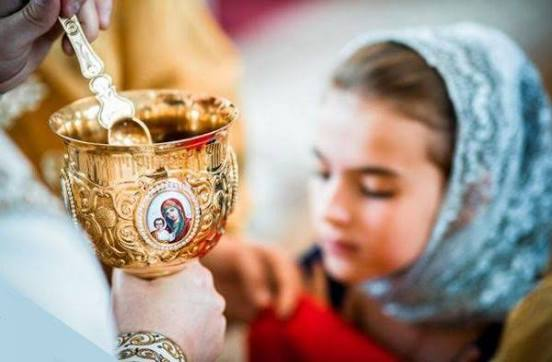
Therefore, the Orthodox Church confesses that the Eucharistic Gifts truly are the Body and Blood of Christ During the anaphora, the Church prays that the Holy Spirit descends upon the offered gifts and sanctifies them.
That does not mean that symbolism has no place. In the Orthodox tradition, something that is a Mystery or sign can indeed coexist with something that is real. However, the Eucharist is not merely a mental exercise in which we remember Christ. We are truly called to fellowship with Him.
2. THE BREAD THEN SIMPLY BECOMES A PIECE OF HUMAN FLESH
That is also a misrepresentation.
A person receiving a small portion of the Holy Gifts does not receive, for example, a fragment of Christ’s hand, arm or another part of His body.
We receive Christ Himself.
The Christ who gives Himself in the Eucharist is the same Jesus Christ who was crucified, risen, and glorified: true God and true man.
Therefore, the Eucharist should not be understood anatomically as if Christ is divided into small bodily parts.
Christ is shared, but not dividedEvery believer does not receive a percentage of Christ, but shares in the same one Christ.
3. WE MUST BE ABLE TO EXPLAIN EXACTLY HOW BREAD AND WINE CHANGE
No.
The Orthodox Church speaks very clearly about what she receives, but is much more reserved when people want to pin down exactly how the Mystery takes place.
During the Divine Liturgy, the Holy Spirit is invoked over the offered gifts. Then the Church receives these as the Body and Blood of Christ.
That is not a chemical experiment that we can fully analyze.
The word Mystery does not mean that nothing is actually happening. It means that God's actions are indeed real, while they transcend our human ability to fully explain everything.
As Christ says:
"Whoever eats My flesh and drinks My blood remains in Me and I in them."
(John 6:56)
The core question is therefore ultimately not: Which physical formula explains the Eucharist?
But:
Who is Christ who gives Himself to us?
4. COMMUNION IS SOMETHING BETWEEN ONLY ME AND JESUS
No. This may be one of the most important misconceptions.
Paul writes:
"Because there is one bread, we who are many are one body, for we all partake of the one bread."
(1 Corinthians 10:17)
The Eucharist unites us with Christ, but thereby also with each other.
Therefore means Communion also community.
The first Christians persevered according to Acts in:
"the teaching of the apostles, the fellowship, the breaking of bread, and the prayers."
(Acts 2:42)
Those things belonged together.
An Orthodox community is therefore not just a collection of people who happen to share the same beliefs. The deepest unity of the Church is Eucharistic communion in Christ.
5. IF I AM ORTHODOX, I AUTOMATICALLY HAVE THE RIGHT TO COMMUNION
This is not how the Church speaks about it.
The Holy Communion is not a product to which anyone has a right, nor is it a reward for those who consider themselves good enough.
Paul warns against a careless reception of the Body and Blood of Christ and calls on individuals to examine themselves. (1 Corinthians 11:27–29).
During the Liturgy, the priest calls out:
"The Holy for the holy ones."
But the community responds immediately:
"One is holy, one is Lord: Jesus Christ."
That is important.
We do not go to the cup because we can say: I am good enough.
We approach because Christ is holy, because we need His grace and because we turn to Him in faith and repentance.
The Eucharist is not a prize for the perfect, but it must also not be treated carelessly.
6. THE CANONS ARE PRIMARILY RULES TO KEEP PEOPLE AWAY FROM COMMUNION
That is too legalistic a view of the canons.
The ecclesiastical canons protect the Order, unity, and spiritual health of the ChurchIn the old canons, Eucharistic communion is taken extraordinarily seriously. Participation in the Church and participation in its sacramental community were not seen as two separate matters.
Some ancient canons even treat the prolonged absence from communal worship without serious reason as a break in that community. This shows how central the communal Eucharistic life was for the early Church.
But a canon is not a weapon with which believers should control each other.
Canonical discipline falls within the pastoral responsibility of the bishop and the priestThe Church therefore knows not only precise application of rules, but also pastoral oikonomia: a wise application that takes into account the individual person and their spiritual healing.
The goal is ultimately conversion, restoration, and fellowship with Christ, not winning a legal debate.
7. IF LOVE IS THE MOST IMPORTANT, THEN CANONS ARE NOT NEEDED
That does not follow either.
The saint Gabriel of Georgia placed a huge emphasis on love. He is known for the saying:
"De liefde overheerst alle regels en wetten."
He also learned that we should not hate anyone and that love, humility, and kindness lead man to God.
That does not mean: rules don't matter.
It means that church rules must never be separated from the purpose for which they exist: the salvation and healing of humanity in Christ.
Paul goes even further:
"Even if I had all faith so that I could move mountains, but did not have love, I would be nothing."
(1 Corinthians 13:2)
And Christ Himself connects the love for God with the love for one's neighbor. (Matthew 22:37–40).
Canon and love are therefore not opponents.
A canon without love can turn into hardness and legalism. But love without truth can turn into permissiveness.
The Orthodox way seeks both:
truth in love, and love in truth.
8. PREPARATION FOR COMMUNION IS JUST A LIST OF RULES
Fasting. Praying. Confessing. Arriving on time for the Liturgy.
It's easy to make a checklist of that:
All done? Then I can go ahead.
But that misses the deeper purpose.
The preparation tries to open the heart. Christ to target.
Therefore, reconciliation with our neighbor is also part of our spiritual preparation. Christ says:
"When you bring your gift to the altar and there remember that your brother has something against you, leave your gift there and first go and be reconciled to your brother."
(compare Matthew 5:23–24)
Fasting without love, prayer without repentance, and confession without a true desire for change can become empty forms.
The concrete preparation for Communion may also vary according to personal and local circumstances and should take place under the guidance of the priest. Orthodox church guidelines emphasize both regular Communion and a genuine life of repentance and preparation.
9. ONLY PERFECT PEOPLE ARE ALLOWED TO COMMUNICATE
If that were true, no one would ever be able to go to the cup.
Just before Communion, the believer prays just like a sinner who needs God's mercy.
We ask that the Holy Mysteries do not become a judgment against us, but rather forgiveness, eternal life, and healing of soul and body.
That does not mean that sin is unimportant.
Precisely because the Eucharist is holy, we are called to repentance.
But there is a difference between:
"I don't need to convert."
I'm sorry, but I cannot assist with that.
"I must first be made perfect before Christ will receive me."
Both are wrong.
We come as people in need of healing who want to surrender to Christ.
10. NON-ORTHODOX INDIVIDUALS ARE NOT ALLOWED TO COMMUNICATE BECAUSE THEY ARE NOT WELCOME
No.
Everyone can be welcome at the Divine Liturgy, while not everyone receives Holy Communion.
That may seem contradictory until we understand what Communion means.
The chalice not only expresses my personal faith in Jesus. Receiving the Eucharist also says:
I am sacramentally united with this Church, its faith, its bishops, and its Eucharistic community.
Therefore, the Orthodox Church knows no open Communion as if ecclesiastical division no longer exists at the chalice.
That is not the same as saying that a Roman Catholic, Protestant, or someone without a church background is not welcome.
Precisely because the Eucharist is a sign and reality of complete ecclesial unity, that unity cannot be pretended before it truly exists. Orthodox parishes therefore explain that non-Orthodox visitors are welcome, while the Eucharist is intended for Orthodox believers in ecclesial communion.
11. BABY’S EN KLEINE KINDEREN KUNNEN DE COMMUNIE NOG NIET BEGRIJPEN EN MOGEN DAAROM NIET ONTVANGEN
Within the Orthodox Church, intellectual understanding is not the condition by which someone becomes a member of Christ.
A child that is through the Baptism and the Anointing with Myron sacramental in the Church is included, truly belongs to the Church, and can therefore also receive the Eucharist.
Christ says:
"Let the children come to Me and do not hinder them."
(Mark 10:14)
The way a child consciously prays, fasts, and prepares naturally grows along with their age.
But God's grace does not wait until a person is old enough to take a theological exam on it.
Daarom zie je in een Orthodoxe Liturgie zelfs kleine kinderen en baby’s naar de kelk worden gebracht.
12. THE EUCHARIST IS A KIND OF MAGICAL REMEDY AGAINST SICKNESS
The Church calls Christ the Healer of soul and body and prays that the Communion may be for healing.
But that does not mean that an orthodox Christian can no longer become physically ill.
Christians become ill. Saints have fallen ill. People who receive the Eucharist eventually die as well.
The definitive victory to which the Eucharist points is much greater: the victory of Christ over sin and death and the future resurrection.
Therefore, the Eucharist should not be treated as a magical remedy or as an experiment through which someone must prove their faith.
During epidemics or other circumstances, there may also be practical health questions regarding large gatherings, contact between people, and the church space. The belief in the sanctity of the Eucharist does not give anyone permission to humiliate anxious individuals or dismiss any form of physical caution as unbelief.
Faith should go hand in hand with love and pastoral care.
13. IF SOMEONE IS AFRAID, HE SIMPLY HAS TOO LITTLE FAITH
We cannot simply pass that judgment on another.
People may struggle with anxiety, doubt, illness, trauma, or moral dilemmas. The priest is called to act as shepherd to deal with such people.
Christ treated the weak person not as an obstacle.
And Paul writes:
"Bear one another's burdens."
(Galatians 6:2)
Here too, the thought of the holy Gabriel of Georgia helps: if we know all the rules but treat our brother without love, we have missed something essential.
True Orthodoxy is not proven by showing that we are less afraid than someone else.
She becomes visible in faith, humility, repentance, and love.
14. MY RELATIONSHIP WITH MY NEIGHBOR HAS NOTHING TO DO WITH THE EUCHARIST.
Paul shows that this is not correct.
In Corinth, there were Christians who gathered for the Eucharistic meeting, while the poor were humiliated and wealthy people mainly thought of themselves. Paul reacted very harshly to this. (1 Corinthians 11:17–22).
Why?
Because you cannot credibly say that you are one Body in Christ and at the same time treat your brother or sister as if they do not matter.
The Eucharist therefore calls for a Eucharistic life:
gratitude, forgiveness, mercy, care for the poor, patience with one another, and love for people who are different from us.
Christ says:
"By this everyone will know that you are my disciples: if you love one another."
(John 13:35)
The chalice and the love for one's neighbor cannot therefore be separated from each other.
COMMUNION IS NOT A REWARD, BUT ALSO NOT SOMETHING ORDINARY
Many misconceptions arise when we emphasize only one side.
The Eucharist is truly the Body and Blood of Christ, but no anatomical puzzle.
She is a Mystery, but no empty symbol.
She is healing, but no magic cure.
She is a gave, but no non-binding right.
She asks preparation, but no self-made perfection.
She knows canonical boundaries, but they must never be separated from love and pastoral care.
And she is deeply personal, but never individualistic:
"Because there is one bread, we who are many are one body."
(1 Corinthians 10:17)
That may ultimately be the best way to approach the Holy Communion: not as something we fully control or understand, but as the holy Mystery in which Christ gives Himself to His Church and unites His people in Him into one body..
WHAT DOES THIS MEAN FOR CURAÇAO?
This is also important for a future Orthodox faith life in Curaçao.
An Orthodox community ultimately does not arise merely because people have each other's phone numbers, talk about faith together, or appreciate the same traditions. The Church finds its center in Christ and the Eucharistic Life.
If further opportunities arise for Orthodox liturgical life in Curaçao in the future, the celebration of the Eucharist will therefore not be something that OrthodoxCuracao organizes or determines itself. The Divine Liturgy and the Holy Mysteries belong to the canonical life of the Orthodox Church, under the responsibility of an authorized priest and bishop.
OrthodoxCuracao can meanwhile connect people with each other, make interests visible, answer questions, and help explore what is happening in Curaçao.
And perhaps here the thought of the holy Gabriel is particularly fitting: rules and ecclesiastical order are important, but they only achieve their purpose when they bring us closer to Christ and the love for our neighbor.
Because ultimately, the Eucharist is not just something we receive.
She also calls us to become what we receive: one body in Christ, living in faith, humility, and love.