



The heart of orthodox church life
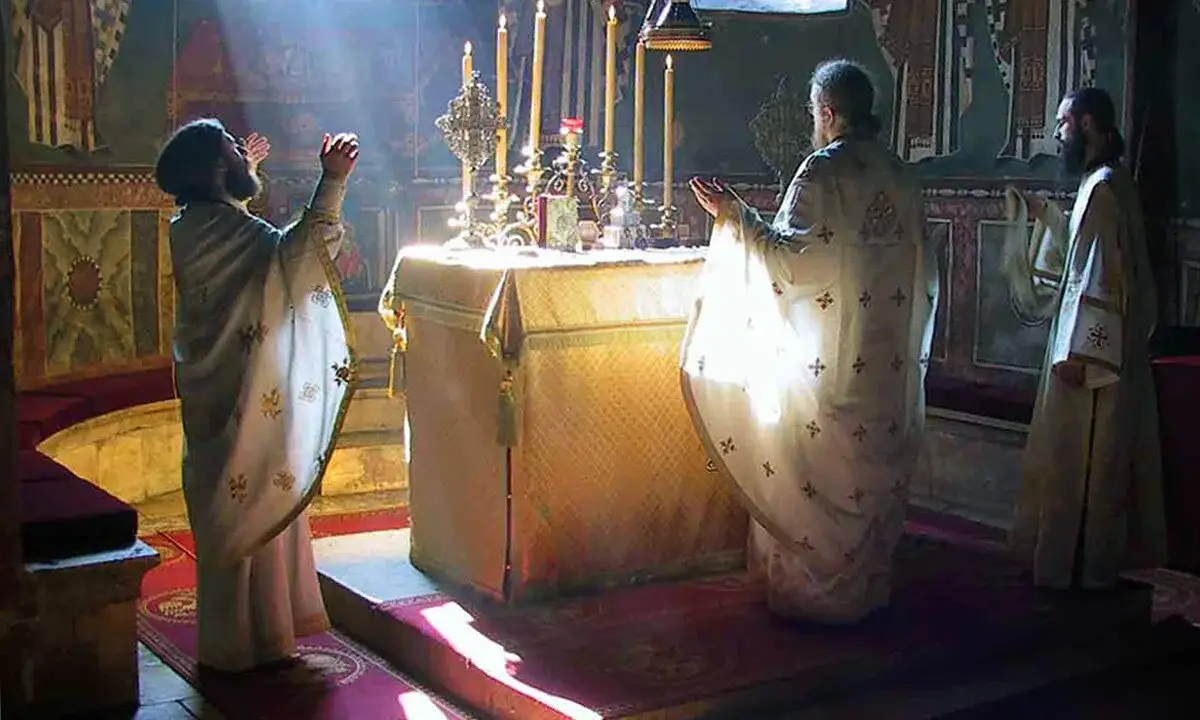
The Divine Liturgy is the central worship service of the Orthodox Church. During the Liturgy, the Church gathers for prayer, the hearing of the Holy Scriptures, and the celebration of the Eucharist.
For Orthodox Christians, the Liturgy is more than a gathering or church service. It is an encounter with Christ and a participation in the life of the Church.
An ancient worship service
The orthodox liturgical tradition has deep roots in early Christianity. The form that is most commonly celebrated today is the Divine Liturgy of Saint John Chrysostom.
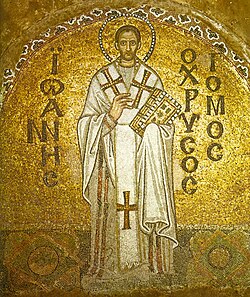
SaintJohn Chrysostom(Greek: Ιωάννης ο Χρυσόστομος; Dutch (obsolete):Saint John Goldenmouth) (Antioch, ca. 345 – Comana, in Pontus, September 14, 407) was a famous preacher, archbishop of Constantinople, from February 26, 398 to 403. He is one of the Church Fathers and was elevated to Doctor of the Church in 1568.
John was known for his powerful exposition of Scripture and his emphasis on prayer, charity, and care for the poor. However, his criticism of wealth, abuse, and the lifestyle of influential people brought him into conflict with the imperial court. Ultimately, he was exiled and died in 407 during his exile.
He is honored as one of the great Church FathersHis name is primarily associated with the Divine Liturgy of Saint John Chrysostom, which to this day is the most celebrated liturgy within the Orthodox Church. Source: Wikipedia – John Chrysostom
On certain days, the Divine Liturgy of Saint Basil the Great celebrated.
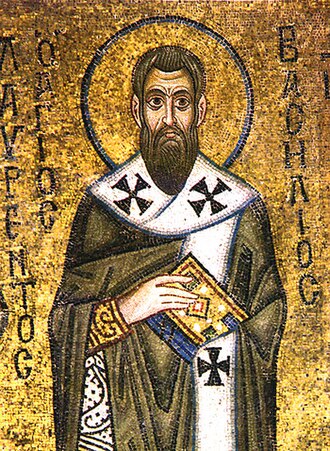
Basil of Caesarea, alsoBasil the Great(Greek: Saint Basil the Great) andFather of Eastern monastic lifenamed, (Caesarea in Cappadocia, ca. 330 – Caesarea, January 1, 379) is a saint and church father.
Basil played an important role in the development of the orthodox monastic life and wrote rules for the common monastic life. Several liturgical prayers are also associated with his name.
Within the Orthodox Church, he is especially known for the Divine Liturgy of Saint Basil the Great, which is celebrated on certain days of the church year. He is venerated as a great theologian, bishop, and saint of the Church. Source: Wikipedia – Basil of Caesarea
What happens during the Liturgy?
PRAYER AND CHANT
- The Liturgy consists largely of prayers, litanies, and chants. The priest, deacon, and believers pray together.
THE HOLY SCRIPTURE
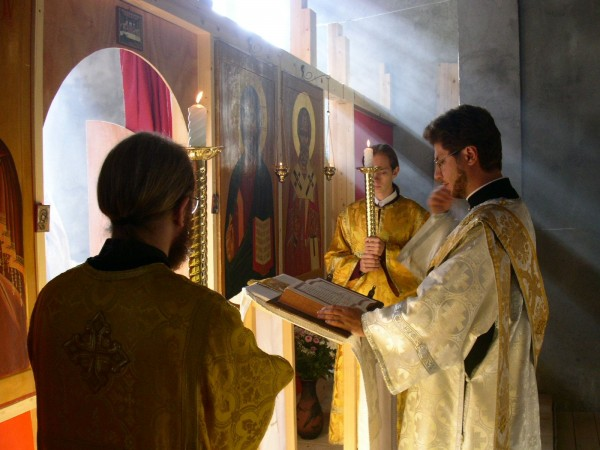
2. During the Liturgy, portions from the letters of the New Testament and from the Gospel are read. The Gospel holds a special place in the worship service.
THE GREAT ENTRANCE
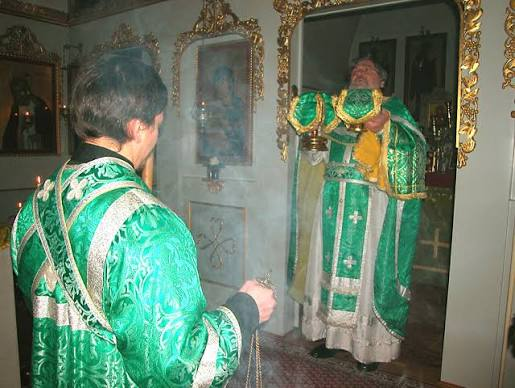
Orthodox subdeacons and priests performing the Great Entrance during the Divine Liturgy. (Wikipedia)
#/media/File:Pokrov14.11.08.jpg)
3. Bread and wine are solemnly brought to the altar in preparation for the Eucharist.
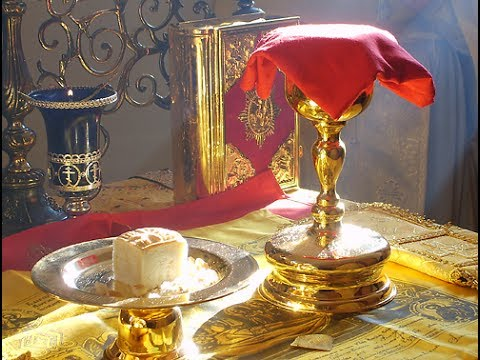
THE EUCHARIST
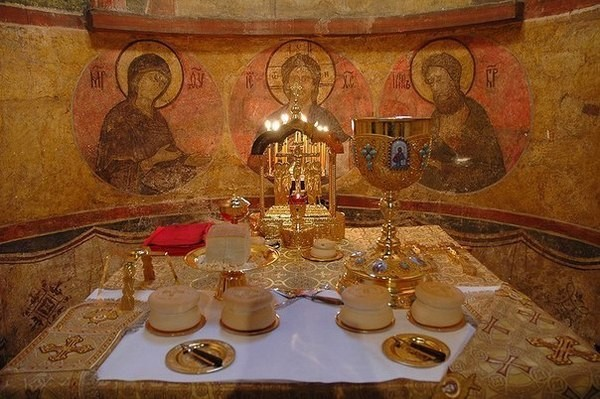
4. The climax of the Liturgy is the Eucharist. The Church thanks God and prays that the Holy Spirit descends upon the offered gifts. Orthodox Christians receive the Body and Blood of Christ in the Holy Communion.
After the Our Father, the faithful prepare for the Holy Communion. The priest prays that Christ Himself sanctifies those present and grants His holy Gifts. The consecrated bread, the Lamb, is lifted with the words: “The Holy for the holy ones.” The believers respond that one is holy: Jesus Christ.
First, the clergy receive the Holy Communion. Then the believers come forward. They receive the consecrated bread and wine together from a spoon. A prayer is said beforehand in which each believer professes their faith in Christ and asks that the Communion be for the forgiveness of sins and healing of soul and body may it be.
During the reception of the Communion, the following is sung:
“Receive the Body of Christ, taste the Source of immortality. Alleluia.”
Within the Orthodox Church, baptized and chrismated children, including young children and infants, also receive Holy Communion as members of the sacramental community of the Church.
HOW DO YOU PARTICIPATE IN AN ORTHODOX SERVICE?
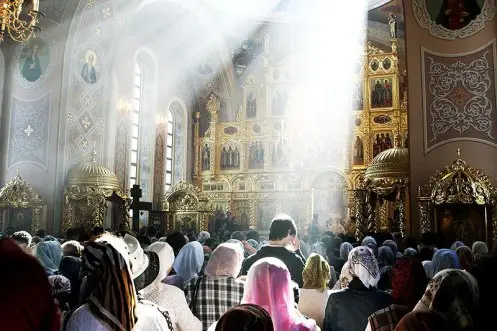
Stand during the service
In many Orthodox churches, the faithful stand for a large part of the Liturgy. Standing is a posture of reverence, attention, and participation in the communal prayer.
In many Orthodox churches, standing is the usual posture during the worship service. However, those who cannot stand for long due to age, illness, or physical limitation may sit. Saint Philaret of Moscow expressed this aptly: "It is better to think of God while sitting than to stand on your legs."
The exact practices may vary by local Orthodox tradition. The exact practices may vary by local Orthodox tradition. The exact practices may vary by local Orthodox tradition. The exact practices may vary by local Orthodox tradition.
Behavior in the church
Those visiting an Orthodox church should arrive a bit before the service begins. This allows for a quiet time to light a candle, pray before the icons, and prepare for the worship service.
During the service, one should try to avoid unnecessary walking around and talking. The most important thing is not to constantly pay attention to what others are doing, but to participate in the prayer with focus. Orthodox practices may vary by parish and local tradition; therefore, as a visitor, you need not be afraid of doing something wrong.
The sign of the cross is also with attention and without haste made. In the Orthodox tradition, three fingers are brought together as a reference to the Holy Trinity, while the other two fingers remind of the divine and human nature of Christ. A bow may follow.
The sign of the cross
During Orthodox services, believers regularly make the sign of the cross. It is a brief physical profession of faith through which a Christian remembers the Cross of Christ and directs themselves to the Father, the Son, and the Holy Spirit.
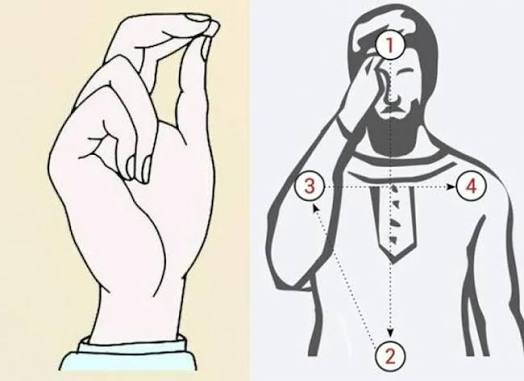
In the Orthodox tradition, the thumb, index finger, and middle finger are brought together. These three fingers refer to the Holy Trinity: God the Father, God the Son, and God the Holy Spirit as the one, indivisible, and consubstantial Trinity. The other two fingers are bent towards the palm and traditionally refer to the divine and human nature of Jesus Christ.
Then one touches:
the forehead → chest/abdomen → the right shoulder → the left shoulder.
It is usually prayed:
“In the name of the Father, and the Son, and the Holy Spirit. Amen.”
After making the sign of the cross, one may bow as a sign of reverence. This way, the gesture is experienced not only with the hand but with the whole body.
The sign of the cross is made, for example, at the beginning and end of prayers, when mentioning the Holy Trinity, during certain moments of the Liturgy, and when entering or leaving a church.
The sign of the cross is therefore not made hastily or thoughtlessly. In the Orthodox tradition, one tries to do it calmly, consciously, and with attention to make. It is a simple gesture, but at the same time a brief confession of the Holy Trinity, the Incarnation of Christ, and His Cross.
Thus, the sign of the cross becomes a visible prayer that accompanies Orthodox Christians both during the Divine Liturgy and in daily prayer life.
Why first right and then left?
In the Byzantine and Orthodox tradition, the cross is made from right to left made over the shoulders. The right side often has a special meaning of honor and blessing in the Bible and Christian symbolism; Christ is described, for example, as seated at the right hand of the Father.
The exact historical reason why East and West ultimately went in different directions is, however, not fully ascertainable. In medieval Western tradition, the sign of the cross was also made from right to left. Later, within the Latin, Roman Catholic tradition, the movement from left to right became customary.
CHEST OR ABDOMEN?
In orthodox explanation, there is sometimes talk about the chest and sometimes about the abdominal area as the second point of the sign of the cross. This difference mainly arises from local custom and way of explaining.
In some Slavic instructions, the belly is mentioned, while in other Orthodox traditions and Western descriptions, it is more often chest or chest area it is said.
The important thing is not an exact anatomical point, but that the sign of the cross is made consciously in the order:
forehead → chest/abdomen area → right shoulder → left shoulder
The movement visibly forms the sign of the Cross over the body.
THE LANGUAGE OF THE ORTHODOX SERVICE
CANDLELIGHT
Lighting a candle can be a visible sign of prayer. The light refers to Christ and expresses that we entrust our prayers, worries, gratitude, and hopes to God. As the flame burns, it can remind us to pray to God with attention and trust.
INCENSE
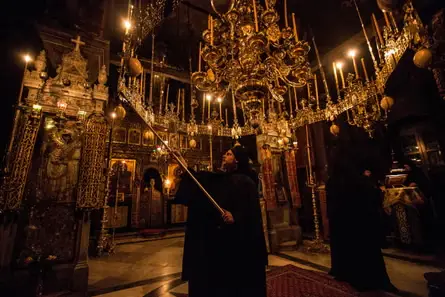
Incense is also an ancient biblical sign of prayer and reverence. Just as the incense rises, so the prayer of the Church ascends to God: “Let my prayer rise before You as incense, and the lifting up of my hands as the evening sacrifice.” (Psalm 140:2, in many English translations Psalm 141:2) The singing carries the prayers and texts of the Liturgy and helps the congregation to pray together.
The icons, the candlelight, the incense, the singing, the gestures, and the processions together form important liturgical elements that help the believer to focus attentively on God and to experience the worship service as a foretaste of the Kingdom of God.
SINGING
Singing carries a large part of the prayers, psalms, and biblical texts of the Liturgy. In the Orthodox Church, there are various singing traditions, including Byzantine singing in the Greek world and various Slavic singing traditions in Eastern Europe.
The human voice is central. In many Orthodox traditions, the worship service is therefore sung without instrumental accompaniment . Priest, deacon, choir, and believers respond to each other and thus participate together in prayer.
Also the psalmody has an important place: psalms are read or sung and together with hymns and other liturgical texts form a large part of the prayer of the Church. The purpose of the singing is not a musical performance in itself, but to make the prayer of the Church audible.
The icons, the candlelight, the incense, the singing, the gestures, and the processions together form important liturgical elements that help the believer to focus attentively on God and to experience the worship as a foretaste of the Kingdom of God.
Can anyone attend a Divine Liturgy?
Yes. Even if you are not Orthodox, you are welcome to attend a Divine Liturgy. You do not need to know exactly what is happening, and you do not have to participate in all the rituals. You can simply be present, listen, and follow the prayers.
The reception of the Holy Communion is, however, reserved for Orthodox Christians who have been prepared according to church practice to receive Communion. Those with questions about this should speak with the priest.
How long does a Liturgy last?
A Divine Liturgy usually lasts longer than many people are accustomed to in other Christian church services. The duration can vary depending on the occasion and location. Often, the service of the Midnight Office or the Hours is also prayed before the Liturgy.
The Liturgy in Curaçao
OrthodoxCuracao is exploring the possibilities for Orthodox faith life in Curaçao. At this moment, we primarily want to connect Orthodox Christians and people interested in Orthodox Christianity with each other.
When opportunities arise for a Divine Liturgy or other Orthodox services in Curaçao, we will share information about it through OrthodoxCuracao.
Would you like to attend a Divine Liturgy?
Do you live in Curaçao and would you be interested in attending a future Orthodox service? Let us know that you are interested. This way, we can get a better picture of the interest on the island.
See also: 10 COMMON MISCONCEPTIONS ABOUT THE ORTHODOX CHURCH