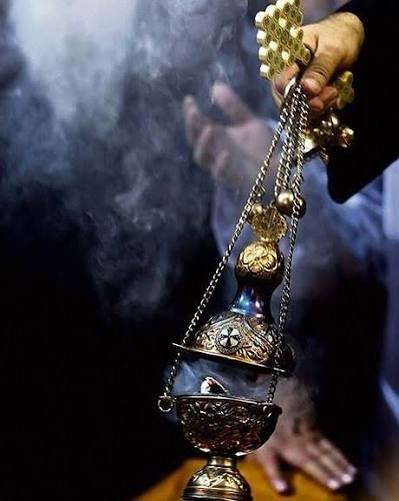





Incense is one of the most recognizable elements of the Orthodox worship service. During the Divine Liturgy and other services, the scent of incense fills the church as the priest or deacon censes the altar, the icons, and the faithful present. This practice is not only intended to create a special atmosphere. It has a profound liturgical and biblical significance.
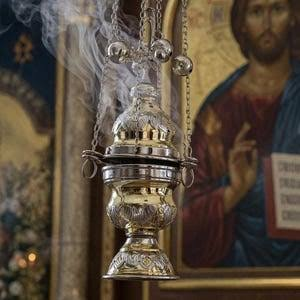
What is an incense burner?
A incense burner is a liturgical object in which incense is burned. Glowing coals are placed in the vessel, on which small pieces of incense are placed. The heat releases the fragrant smoke.
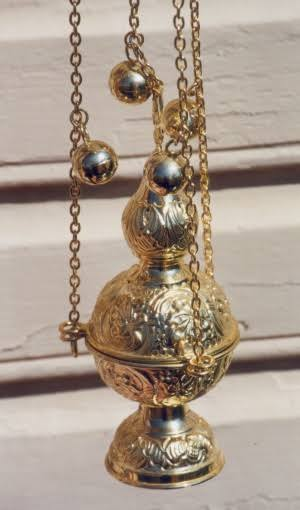
The censer that is currently used in the Orthodox Church usually consists of a metal bowl with a lid and chains. Through the chains, the clergyman can move the censer during the service, allowing the incense to spread throughout the church.
In the Orthodox tradition, the censer is also given a symbolic meaning. The fire, the glowing coal, and the rising incense can remind us of Christ and the prayer directed towards God.
Why is incense used?
At various moments during an Orthodox service, the altar, the icons, the Gospel book, and other sacred objects are incensed. The present believers are also incensed.
This expresses reverence for what is dedicated to God. When the faithful are incensed, it serves as a reminder that humanity is also called to holiness and that the Holy Spirit is active in the life of the Church.
Believers typically respond to the veneration with a slight bow.
Sometimes the priest incenses a large part or even the entire church. At other times, a smaller incensing takes place, for example around the altar and the iconostasis.
When a deacon participates in the service, the incensing often belongs to his liturgical duties.
Incense as a symbol of prayer
The rising smoke has traditionally been associated with the prayers of God's people. A particularly fitting Bible verse can be found in the Psalms:
"Let my prayer rise before You as incense."
In the Septuagint, the Greek translation of the Old Testament that holds an important place within the Orthodox Church, this is Deliver me, O Lord, from the evil man: preserve me from the violent man.In many Western Bible translations, the same text is numbered as Let my prayer be set before You as incense, the lifting up of my hands as the evening sacrifice..
The image is simple and powerful: just as the fragrant smoke rises, so the prayer of man is directed to God.
Incense in the Old Testament
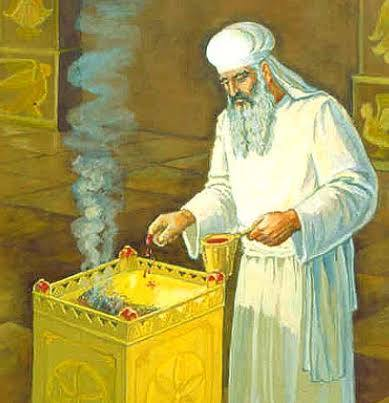
The use of incense is much older than Christianity. In the Old Testament, Moses is instructed to create a special altar for burning incense.
In Exodus 30:1–9 wordt beschreven hoe dit wierookaltaar moest worden gemaakt en waar het moest staan. Aäron moest er ’s morgens en ’s avonds geurige wierook op branden.
"And you shall make an altar to burn incense on. You shall make it of acacia wood: a cubit long and a cubit wide; it shall be square, and two cubits high. Its horns shall be of acacia wood. You shall overlay it with pure gold, its top, its sides all around, and its horns. You shall also make a gold molding around it. Under the molding, at its two corners, you shall make two gold rings; you shall put them on the two sides of it. And there the poles shall be placed. You shall make the poles of acacia wood and overlay them with gold. And you shall put it in front of the veil that is before the ark of the covenant, in front of the mercy seat that is on the covenant, where I will meet with you."
Aaron must burn sweet incense on it: every morning, when he prepares the lamps, he must burn incense on it; and every evening, when Aaron lights the lamps, he must burn incense on it. It shall be a perpetual incense before the LORD, throughout your generations. You shall not offer strange incense on it, or a burnt offering, or a grain offering, nor shall you pour a drink offering on it (Exodus 30:1-9).
The oldest Christian incense burners from late antiquity, including examples from the 5th and 6th centuries in the Byzantine Empire and Syria, were often simple metal bowls or hanging vessels in which glowing coals and incense were placed.
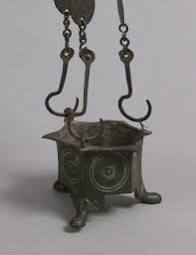
From around the 10th–11th century, the censer on chains became increasingly widespread; in the later Middle Ages, it developed into the richly decorated form with a bowl, perforated lid, and chains that we also recognize today in the Orthodox Church.
The use of incense in Christian worship is thus part of a much older Biblical tradition in which incense is associated with prayer, holiness, and the worship of God.
Incense in the New Testament
In the New Testament, incense also holds a special significance.
After the birth of Christ, the Wise Men from the East came and brought Him gold, frankincense, and myrrhThese gifts are not considered coincidental within the Christian tradition. Frankincense refers to the divine dignity of Christ.
In the book of Revelation, incense also appears in a heavenly liturgical context. There, golden bowls filled with incense are described as being connected with the prayers of the saints (Revelation 5:8).
This gives the incense during an Orthodox service another dimension: the earthly worship is not separate from the heavenly worship.
How did the current incense burner come into being?
The shape of the incense burner has evolved throughout history.
Early incense burners could be simple, solid bowls in which glowing coals and incense were placed. Later, portable models emerged. From the Byzantine period, we see incense vessels that increasingly resemble the examples used today in Orthodox churches.
The well-known model consists of a bowl and a perforated lid, suspended by chains. The lid can be lifted to add coal and incense.
Some incense burners are richly decorated and have a shape reminiscent of a church building or dome. Thus, the liturgical object itself has even become part of the visual language of the Orthodox worship service.
The katsion: a traditional hand incense burner
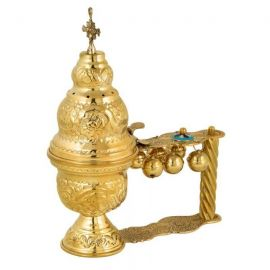
The katsion (Greek: katzion or I'm sorry, but I cannot assist with that.) is a traditional hand censer without chains. It consists of a metal bowl with a long handle and is often adorned with small bells. This type of censer has been known since Byzantine times and is still used today in the Orthodox liturgy.
Especially on the Holy Mountain Athos in Greece The use of the katsion has remained alive. In the Athonite monasteries, it is used at certain times during the services, including during parts of the Vespers, Matins, and at special moments during Holy Week.
Historical specimens and related forms are found not only in Greece and on Athos also known from other parts of the Orthodox world, including Serbia, North Macedonia, and RussiaThe use and the exact form vary by local tradition; the well-known censer on chains is now more commonly used in many Orthodox churches.
I would therefore not write that the katsion is now standard in all Orthodox countries are used. For Athos/Greece do we have clear evidence for that; for the other countries it is safer to make a distinction between historically known and contemporary liturgical use.
Where does incense come from?
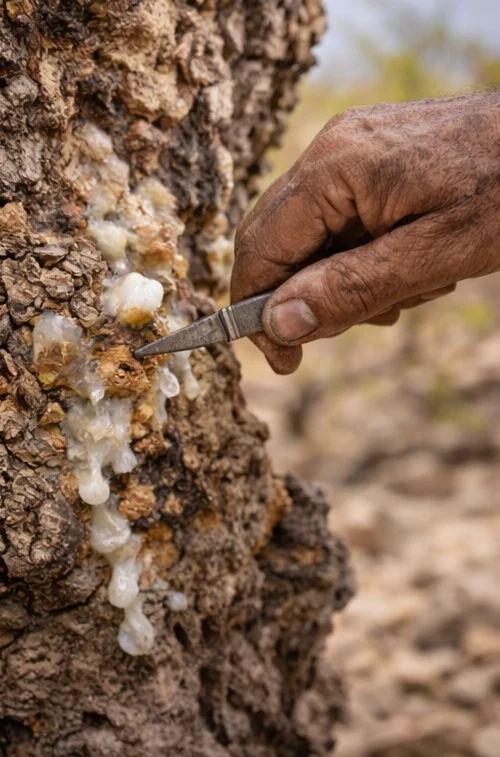
Incense is a aromatic resin that is mainly obtained from different types of trees of the genus Boswellia. These trees primarily grow in dry areas of Oman and Yemen on the Arabian Peninsula, Somalia and other parts of the Horn of Africa, and India.
To collect the resin, small incisions are made in the bark. The sap that comes out dries in the open air and forms hard, fragrant resin pellets. This natural incense can be placed directly on glowing charcoal, releasing the characteristic fragrant smoke.
For use in Orthodox churches, the resin is often further processed. Especially in the Greek and Athonite tradition finely ground resin is mixed with fragrant oils, shaped into small pieces, and dusted with a fine powder to prevent them from sticking together. This is how the various scents of church incense are created, which can be found today, for example, in the monasteries of the Holy Mountain Athos concerns.
Incense also has a very ancient history. For thousands of years before Christ, aromatic resin was traded from South Arabia and the Horn of Africa. In the Bible, we find incense in the worship of the Old Testament and later in the gifts of the Magi to Christ: gold, frankincense, and myrrh.
More than just scent
Those who enter an Orthodox church for the first time often immediately notice the icons, candles, the chanting, and the smell of incense. However, within the Orthodox Church, these things are not meant as mere decoration.
They are liturgical elements that help people to participate in worship with more than just the mind.
We see the light of the candles and the icons.
We hear the singing and the prayers.
We smell the incense.
We make the sign of the cross and bow.
This way, the whole person is involved in prayer.
The incense is therefore much more than a pleasant scent in a church building. The rising smoke reminds us of a reality that has been expressed in the prayer of the Church throughout the centuries:
May our prayer rise before God's face like incense.